
The Cornish Walk That Changed My Life
The walk starts in Penberth. If you don’t know it, that’s the point — a tiny granite cove with a slipway and a handful of fishing boats hauled above the tideline. No car park to speak of. No sign telling you it’s special. You just drop down the valley through the trees and there it is, the sea filling the gap between the hedgerows like someone left a door open.
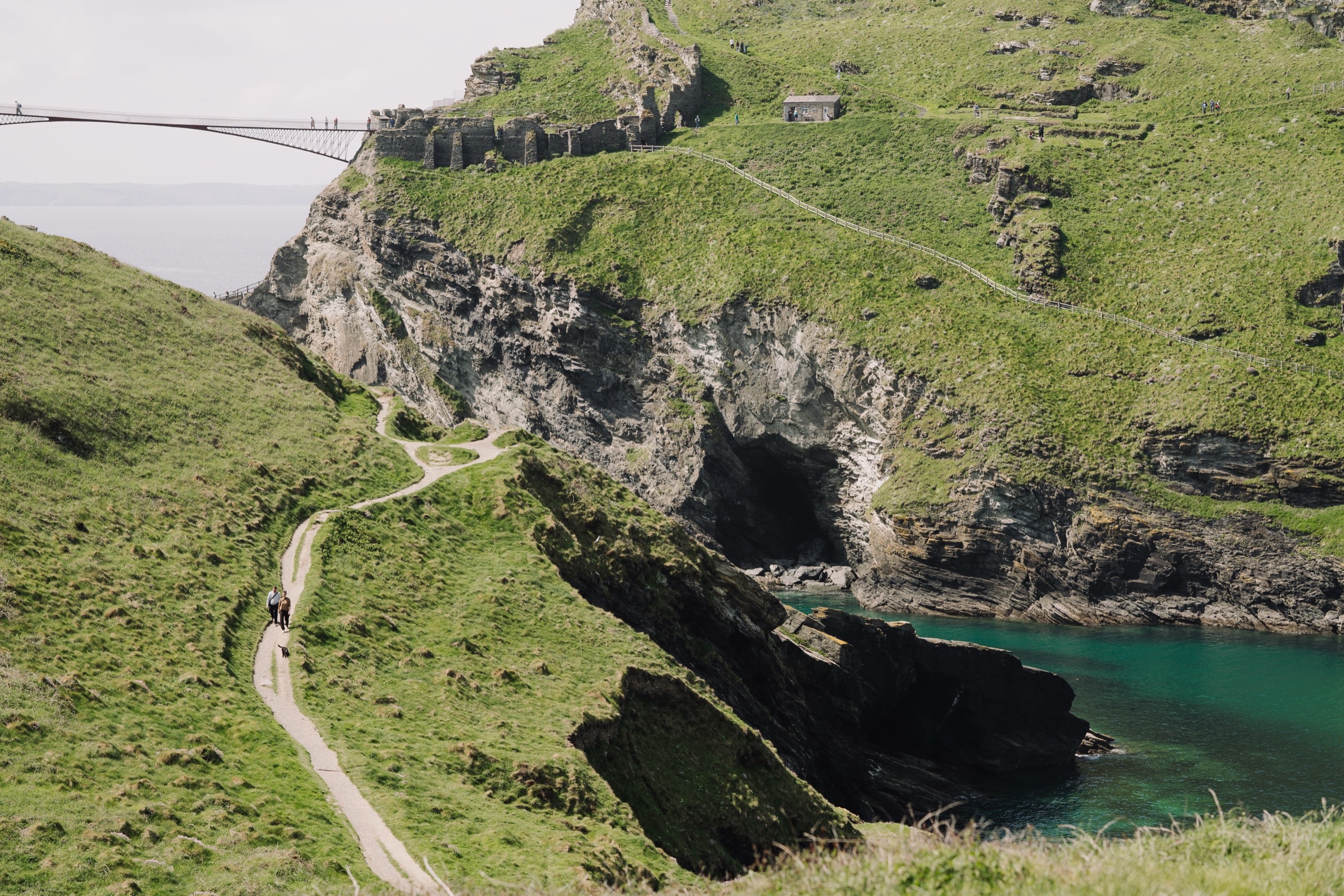
From Penberth, the coast path climbs to Logan Rock — a seventy-tonne boulder perched on the clifftop that rocks when you push it. Or it’s supposed to. In 1824, a young naval lieutenant called Goldsmith tipped it off its pivot on a dare. The Admiralty made him put it back at his own expense. It hasn’t rocked quite right since, but that’s not why you go. You go for the view — the headland falling away on three sides, the Atlantic stretching to nothing, the particular feeling of standing somewhere that has been exactly this way for a very long time.
I proposed to Alice up there. A couple of years after the first time I’d done that walk, when I already knew this stretch of coast was going to rearrange my life, I took her up to Logan Rock and asked her. She said yes. Below us, Pedn Vounder was doing what it always does: turquoise water, white sand, the kind of scene that makes people stop and check they’re still in England.
From Logan Rock, you drop down to Pedn Vounder itself — a scramble down the cliff, worth every step — and swim. The water is cold and impossibly clear. You float there looking back up at the headland and the rest of the world feels a long way away.
The path climbs again from there to Porthcurno, a beach that would be world-famous if it were anywhere warmer, and then climbs again to the Minack Theatre — an open-air amphitheatre carved into the granite cliff above the sea. Every time I see it, it stops me. The stage sits sixty feet above the Atlantic, and in the evening the light comes in low from the west and turns the stone gold. It shouldn’t exist. It does.
The last stretch takes you to Porth Chapel — a cove you have to know about to find, tucked below the path with no signs and a scramble down the rocks to reach it. The kind of place that rewards the walk. Then back through the fields to Treen, where the day ends the only way it should: at the Logan Rock Inn, with a pint of Tribute and fish and chips.
I’ve done a lot of walks. I’ve eaten in a lot of pubs. The Logan Rock Inn is, in my opinion, the best pub in England — not just Cornwall. That’s a statement I’m prepared to defend. The beer is good, the food is honest, and you’re sitting in a garden where the fields run down to the cliff edge and the day’s walk is still in your legs. There’s nothing else you need.
I may be biased, but I think this single walk takes in the best beach in England, the best viewpoint in England and the best pub in England. All in one afternoon. That walk changed my life in stages. The first time, it changed how I saw Cornwall. I’d visited before, done the usual things. This was different. This was Cornwall showing me what it actually is when you slow down and go on foot.
The second time, it changed my family. I proposed. A couple of years after that, Alice and I moved our lives down here.
Now I do some version of this walk every day. Not always the full loop — sometimes it’s just the dog walk along the cliffs in the morning, watching the light do something new to the sea. But every morning is still a marvel. I haven’t got used to it. I don’t think I will.
Evenings are spent surfing at Sennen, or an evening dip at Porthcurno when the beach empties and the water turns glassy. Pizza from the van at Sennen while the sun drops behind the Brisons. The ordinary stuff of living here — except none of it feels ordinary, even now.
This is why Kernara exists. Not because Cornwall needed another tour company, but because what I found on that walk — the depth of it, the beauty that only reveals itself at walking pace, with someone who knows where to look — felt too good to keep. It needed to be shared.
Every Kernara tour is built around that principle. We find the people who know Cornwall the way I’ve come to know this one stretch of coast — deeply, personally, through years of walking it — and we ask them to show you what they see. The coves that don’t have signs. The pubs that don’t need them. The history that’s right there in the stone if someone points it out. It’s the kind of shift in perspective our guided walking tours of Cornwall are designed to create.
That’s all it is, really. The walk that started everything, offered to someone new.
Topics