
A Brief History of Cornwall's Tin Mining Heritage
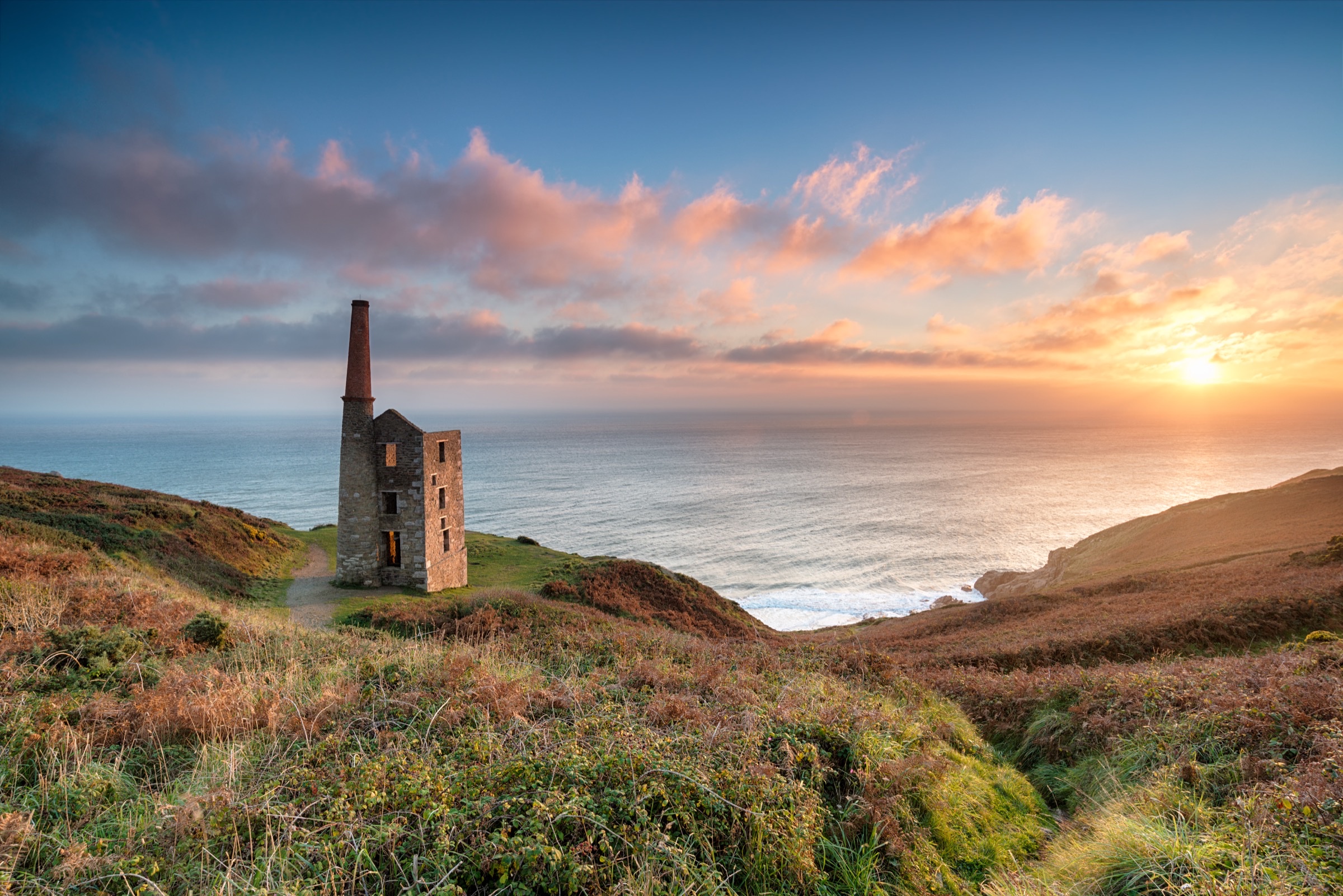
The engine houses at Botallack cling to the cliff face like something the rock grew on its own. Two small stone buildings — the Crowns — perched above the Atlantic, their chimney stacks pointing at the sky, their shafts dropping hundreds of feet below the ocean floor. Stand on the coast path above them and it’s hard to believe that men went down there. That they worked by candlelight in tunnels carved under the sea, listening to boulders rolling on the seabed above their heads.
But they did. For centuries.
Tin mining in Cornwall stretches back to the Bronze Age — at least 2000 BC, when Phoenician traders are said to have sailed to the Cornish coast to buy the metal that made bronze possible. For millennia, Cornwall’s tin helped shape the ancient world. By the time the industry reached its peak in the eighteenth and nineteenth centuries, the county was producing the majority of the world’s tin and copper, and the landscape was transformed by it — engine houses, spoil heaps, tramways, harbours built to ship ore across the globe.
The scale is hard to grasp now. At its height, tens of thousands of Cornish men, women and children worked in the mines. The engine houses — those distinctive silhouettes that line the cliffs from St Just to St Agnes — were built to house the beam engines that pumped water from ever-deeper shafts. Some mines ran for miles underground. Some ran beneath the sea. The noise, the heat, the danger — it’s all gone now, replaced by wind and silence and the slow work of weather on stone. But the buildings remain.
In 2006, the Cornwall and West Devon Mining Landscape was designated a UNESCO World Heritage Site, recognising what the mines gave the world: not just metal, but engineering, innovation and a diaspora that carried Cornish expertise to every mining frontier on earth. Cornish miners — known as Cousin Jacks — emigrated to Mexico, South Africa, Australia, the American West. Wherever there was rock to break and ore to find, there was usually a Cornishman who knew how. The pasty travelled with them — a portable lunch designed for underground, crimped at the edge so a miner could hold it with dirty hands and throw away the crust.
Geevor Mine, near Pendeen, was one of the last tin mines in Cornwall to close. It shut in 1990, and the silence that followed was the end of something that had defined this landscape for four thousand years. Today Geevor is a museum, and you can walk underground into the eighteenth-century tunnels — low, narrow, damp, lit by the kind of light that makes you understand what darkness really means. The sound of dripping water follows you in and stays with you after you leave.
Angie — the Kernara guide who leads the Legacy and Landscapes tour — has a particular passion for this history. She’s a Blue Badge guide with a deep knowledge of industrial heritage, and she reads the landscape the way other people read books. A pile of stones becomes a count house. A depression in the turf becomes a collapsed shaft. A stretch of cliff that looks empty reveals, under her eye, the traces of an industry that changed the world. She’ll stand at Botallack and tell you about the men who worked the Crowns engine houses, about the candles and the ladders and the six-hour shifts in tunnels so hot that miners worked stripped to the waist — and suddenly the ruin on the cliff edge becomes a workplace, full of noise and sweat and purpose.
The mines are silent now. The engine houses stand open to the sky, their roofs gone, their machinery sold or scrapped. But they haven’t become ruins in the usual sense. They’ve become monuments — shaped by the same wind and rain that shaped the cliffs they sit on, as much a part of the coastline now as the granite itself.
Walk the tin coast on a winter afternoon, when the light is low and the stone turns gold, and you’ll feel it — the weight of what happened here. Not sadness, exactly. Something closer to respect.
Topics