
A Complete Guide to Tintagel Castle and King Arthur
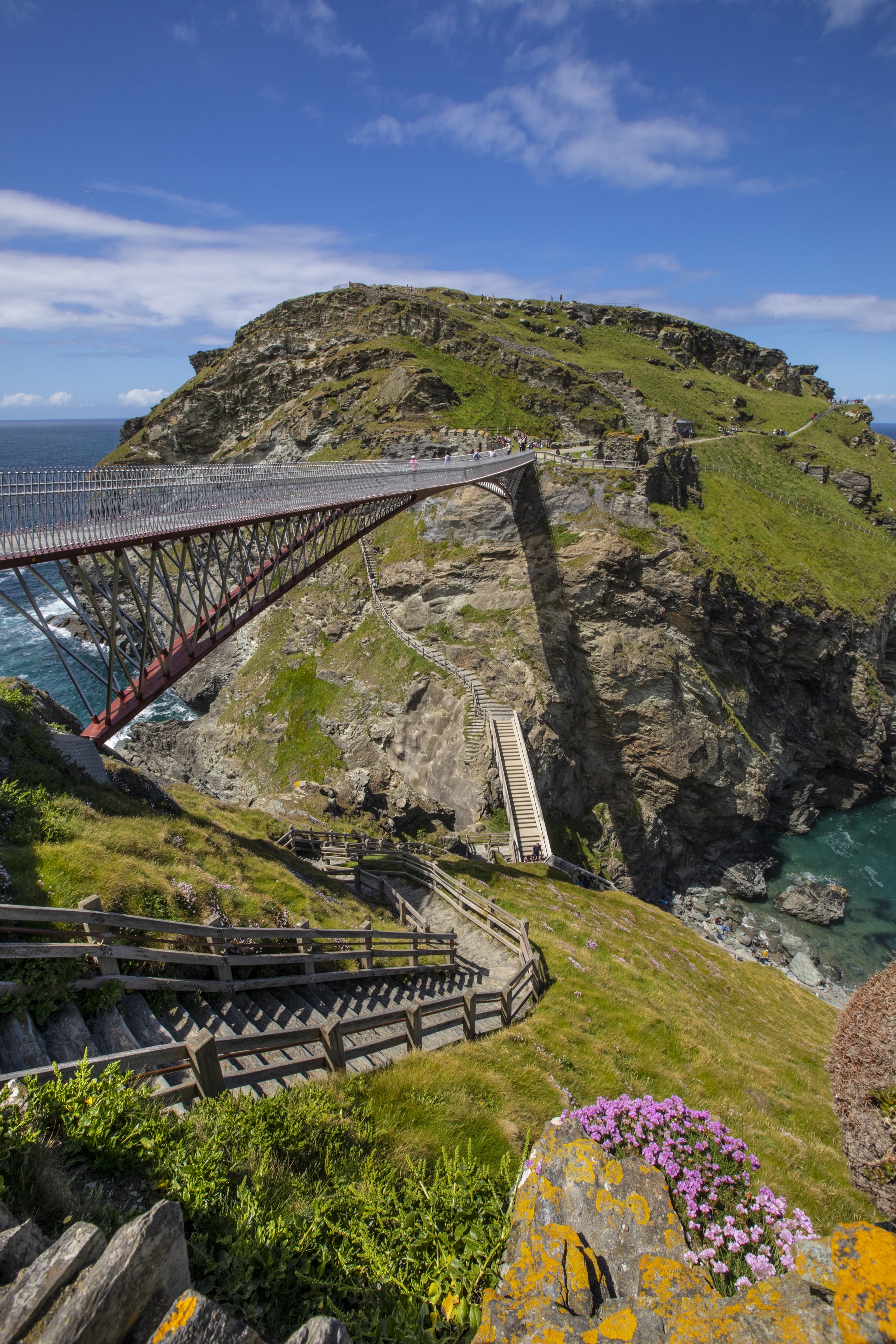
The first thing you see is the gap. The headland has pulled away from the mainland over centuries, leaving a narrow chasm where the sea churns far below, and the castle — or what remains of it — sits on the far side, exposed to every storm the Atlantic can muster. A modern footbridge spans the divide now, slim and elegant, and walking across it with the wind in your face and the waves below, you begin to understand why this place has held the imagination for nearly a thousand years.
This is Tintagel. And whether or not a king called Arthur ever stood here, something powerful did.
Before the legend
The site has been inhabited since at least the late Roman period — the 5th century AD — and the archaeological evidence tells a story that needs no embellishment. Fragments of fine pottery and glass from the Mediterranean have been excavated from the headland, the kind of luxury goods that arrived by ship from distant trading ports. In the 5th to 7th centuries, whoever controlled this promontory was wealthy, well-connected and deliberately positioned at the edge of the known world.
This was not a backwater. It was a gateway.
The pottery fragments alone — amphorae from the eastern Mediterranean, fine tableware from North Africa — suggest a community trading across vast distances at a time when much of post-Roman Britain was turning inward. Tintagel was looking outward, across the sea, to places most people in Britain had forgotten existed.
Enter Arthur
In 1136, Geoffrey of Monmouth published his Historia Regum Britanniae — a sprawling, largely invented history of the kings of Britain — and placed the conception of King Arthur at Tintagel. According to Geoffrey, Uther Pendragon entered the castle disguised by Merlin’s magic and spent the night with Igraine, Duchess of Cornwall. Nine months later: Arthur.
Geoffrey was a storyteller, not a historian. But he was brilliant at matching a legend to a landscape. Standing on the headland, with the sea crashing against the rocks below and the ruins stretching across the cliff like broken teeth, the story feels earned. You don’t have to believe in Arthur to feel the weight of the place.
The castle you can see
The ruins that stand today are not Arthurian. They are 13th-century — built in the 1230s by Richard, Earl of Cornwall, brother of King Henry III. Richard was one of the wealthiest men in Europe, and he built his castle here almost certainly because of the Arthurian connection. A medieval prince commissioning a fortress on the strength of a legend. The story was already powerful enough to shape stone.
English Heritage manages the site today, and the approach from the coast path — whether you come from the north along the high cliffs or from the village below — remains one of the most dramatic walks to any building in England.
Merlin’s Cave and the Gallos
Below the castle, at sea level, Merlin’s Cave cuts through the base of the headland. At low tide you can walk through it — the roof dripping, the Atlantic surging at your ankles, the light changing as you pass from one side to the other. It’s named for the legend, of course, but the cave needs no mythology. The sound of the sea inside it, the darkness and the cold, the sudden brightness as you emerge — that’s enough.
Above, on the headland, the Gallos sculpture stands in silhouette against the sky. A life-sized bronze figure, cloaked, facing the wind. It was installed in 2016, inspired by the Arthurian legends but deliberately ambiguous — it could be Arthur, Merlin, a monk, a trader. It belongs to whatever story you bring to it.
Walking to Tintagel
The best way to arrive is on foot. The coast path from the north brings you along the cliff edge with the sea below and the castle appearing gradually, the headland separating from the mainland as you approach. It is a walk that builds — the view changes with every turn, and by the time you cross the bridge, you’ve earned the arrival.
Tintagel features on three of our tours. David walks the wild North Coast approach on The Hidden North. Gail brings guests from the south on From Coast to Castle, connecting the castle to the wider story of Cornwall’s medieval power. And Evie, on Sacred Cornwall, reads Tintagel through the lens of the early saints and the spiritual landscape that predates even Geoffrey’s legend.
Each guide sees something different in the same stone.
The wind was up when we last walked the headland. The Gallos figure stood with its back to the mainland, facing out to sea, and the waves were hitting the rocks below with a sound like applause. Whatever happened here — trade, kings, invention — the place itself is not finished with its story.
Topics