
The Best Beaches in Cornwall
Cornwall has more than three hundred beaches, and arguing about the best ones is practically a local sport. Some are wide and windswept, built for surfing and long walks. Others are tucked into cliff faces and reached by steep paths, the kind of places that feel like you have discovered something. These are the Cornwall beaches our guides return to, grouped by coast so you can plan around where you are staying. Many of them sit on the South West Coast Path, so the best way to reach them is often on foot.
The north coast: surf beaches and big skies
The north coast faces the full Atlantic, and its beaches are wide, open and alive with waves. Come for long walks at low tide, surfing, and sunsets over the sea.
Fistral Beach, Newquay
Fistral is Cornwall’s most famous surf beach, and it earns its reputation every day. A wide crescent of sand facing the full force of the Atlantic, with waves that build and break with a consistency that draws surfers from across the world. Even if you never pick up a board, standing on the beach at Fistral with the spray on your face is something you feel in your chest.
Watergate Bay
Two miles of golden sand backed by low cliffs, just north of Newquay. At low tide the beach is enormous, and it is one of the best places on the north coast for a long, unhurried walk with the surf beside you.
Holywell Bay
A broad beach framed by dunes, with two rocky islets offshore that give it one of the most recognisable views on the coast. It is a short walk from the village, and quieter than the beaches around Newquay.
Bedruthan Steps (Carnewas)
Huge slate stacks march along the sand below the cliffs here, and the view from the clifftop is one of the great sights of the north coast. The staircase down to the beach is steep and is sometimes closed for safety, so check before you go; the view from above is worth the stop either way.
Godrevy and Gwithian
Three miles of sand curve around St Ives Bay to Godrevy lighthouse, the one that inspired Virginia Woolf’s To the Lighthouse. Walk to the headland and look down into the coves below: grey seals often haul out here.
Porthmeor, St Ives
St Ives’ Atlantic-facing beach sits right below the Tate gallery, with the town’s granite cottages at one end. It catches the evening light beautifully and is easy to combine with an afternoon in town.
The far west: white sand and turquoise water
Around Land’s End the granite cliffs shelter some of the most striking beaches in Britain, with pale sand and water so clear it looks Mediterranean.
Pedn Vounder
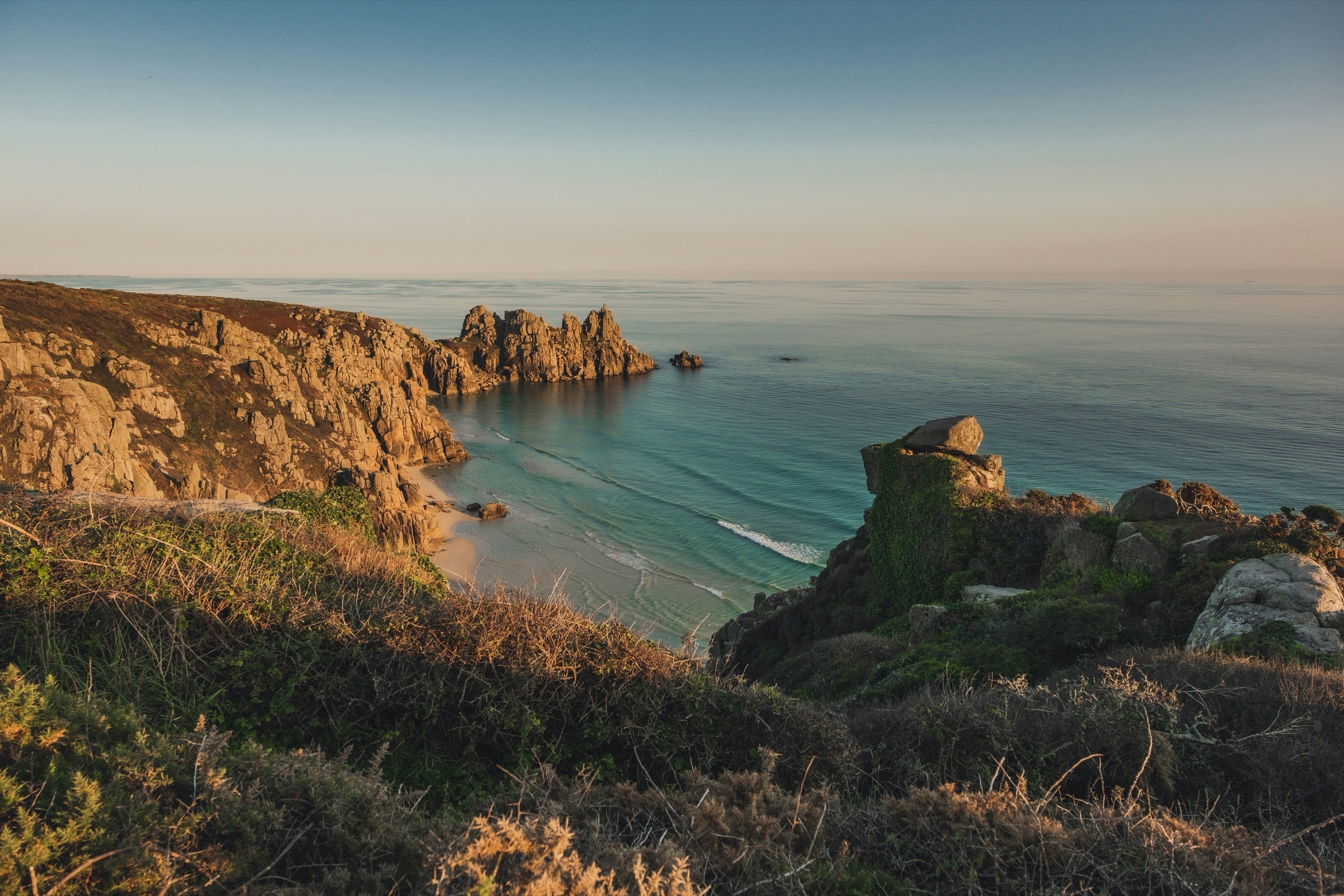
Below the headland at Logan Rock, Pedn Vounder sits at the base of the cliffs like something displaced from the Caribbean: white sand, water that shifts between turquoise and deep green, and a silence broken only by waves. Getting down requires a steep scramble that puts off the casual visitor, which is part of why the beach feels the way it does. From the coast path above, the view is almost absurd in its beauty.
Porthcurno
Pedn Vounder’s neighbour, a cove of soft white sand beneath the open-air Minack Theatre, cut into the cliff above. It is easier to reach than Pedn Vounder and just as beautiful.
Sennen Cove
A long sweep of sand at the edge of England, a mile or so from Land’s End. The walk between the two along the coast path is one of the most dramatic short walks in Cornwall.
The Lizard: Cornwall’s most southerly beaches
The Lizard peninsula is the most southerly point of mainland Britain, and its rock gives its beaches colours you will not see anywhere else.
Kynance Cove
Deep green and red serpentine rock, white sand and turquoise water, with natural arches to walk through at low tide. It is one of the most photographed places in Cornwall, and best reached on foot along the clifftop. See it among our must-see views in Cornwall.
Church Cove, Gunwalloe
A small sandy cove with a medieval church tucked into the dunes beside it. Quiet, sheltered and unlike any other beach in the county.
Poldhu Cove
A sandy, family-friendly cove on the west side of the Lizard, close to the clifftop where Marconi sent the first transatlantic radio signal in 1901.
The south coast: sheltered coves and harbours
The south coast is gentler, with calmer water for swimming and beaches tucked into wooded estuaries and harbour towns.
Marazion
Marazion’s beach is defined by what rises from the water at its far end: St Michael’s Mount, a castle on a tidal island connected by a cobbled causeway that the sea covers twice a day. At low tide you walk across ancient stones to the island. At high tide the Mount floats on the water, distant and medieval. The light here in the early morning, soft and silvered, is the kind that makes you stop and stand for a while.
Lantic Bay
A secluded crescent of sand near Polruan, reached by a steep path from the coast path above. The climb back up is real, but the water is some of the clearest on the south coast and the beach is rarely busy.
Readymoney Cove, Fowey
A small, sheltered cove at the mouth of the Fowey estuary, a short walk from the town. Daphne du Maurier lived in a cottage here, and it is the perfect start to a walk along the coast path to St Catherine’s Castle.
When to visit Cornwall’s beaches
July and August bring the warmest sea and the busiest beaches. For walking and quieter sand, May, June and September are our favourites, and the sea holds its warmth well into autumn. Many beaches change completely with the tide, so check tide times before you set out, especially for coves like Kynance and Pedn Vounder. For where the beaches fit into the wider coastline, see our guide to the Cornish coast.
Walk Cornwall’s beaches with Kernara
Many of these beaches sit on the routes our guides walk every week, and the best way to see them is from the coast path, arriving on foot. Every Kernara Cornwall tour includes a local guide, handpicked hotels and every detail arranged. Enquire to walk the coast with us.
Topics