
Things to Do in Cornwall
Cornwall packs more into its 300-odd miles of coastline than almost anywhere in Britain, and the hardest part of any visit is deciding what to leave out. This is our guide to the best things to do in Cornwall, written by the guides who spend their lives here. It leans towards the slow and the local: the coast paths, the harbours and the gardens rather than the queues and the car parks. Every one of them can be built into a Kernara guided tour.
Walk a stretch of the South West Coast Path
Cornwall’s greatest attraction is free and runs the whole way around it. Roughly 300 miles of the South West Coast Path trace the county’s cliffs and coves, and you do not need to walk all of it. A single morning between two headlands, with a guide who knows where the seals haul out and where to stop for lunch, is Cornwall at its finest. Our guide to walking in Cornwall has the best sections.
Watch a play at the Minack Theatre
Carved into a granite cliff above Porthcurno, the Minack is an open-air theatre with the Atlantic as its backdrop, and there is nowhere else like it in Britain. A summer evening performance, the sea shifting from blue to gold behind the stage, is worth planning a whole trip around. Bring a cushion and a blanket. See what to expect from a show at the Minack.
Eat fresh seafood on a working harbour
Cornwall’s food has quietly become world-class. In the fishing villages of Padstow and Port Isaac you can eat crab landed that morning; in Porthleven and Newlyn the harbour and the kitchen are one and the same. Book the tasting menu if you like, but also eat the crab sandwich on the harbour wall. More in our Cornwall food and drink guide.
Wander the sub-tropical gardens
Warmed by the Gulf Stream, Cornwall grows things that should not survive in Britain. The Lost Gardens of Heligan near Mevagissey, and Trebah and Glendurgan near Falmouth, are the finest: tree ferns, palms and hidden valleys running all the way down to the sea.
Stand on the Arthurian cliffs of Tintagel
On the wild north coast, legend and geology collide at Tintagel, where the ruins of a medieval castle cling to a headland said to be the birthplace of King Arthur. The clifftop footbridge and the beach cave below are worth the climb. Tintagel anchors our From Coast to Castle tour.
Lose an afternoon in St Ives
The light that drew the modernists still draws everyone else. St Ives has three beaches, a Tate gallery, the Barbara Hepworth sculpture garden and a warren of harbour lanes. Go early or late in the day to have it to yourself; it is one of the best places to visit in the county.
Cross to St Michael’s Mount
At Marazion, a cobbled causeway appears at low tide to carry you across to St Michael’s Mount, a castle and church crowning a tidal island. Time your walk with the tide, or take the small boat back as the water returns and the causeway disappears beneath it.
Trace the mining heritage of the Tin Coast
Around St Just, the ruined engine houses of Botallack and the Geevor and Levant mines stand on the very edge of the cliff, a UNESCO World Heritage landscape that once helped power the industrial world. It is Poldark country, and far more moving in person than on screen.
Surf… or learn to
Cornwall is Britain’s surf capital. Fistral at Newquay is the famous break; Watergate Bay, Polzeath and Sennen are gentler places to take a first lesson. Even watching from the sand with a coffee, surfers streaming down to the water, is a fine way to spend an hour.
Marvel at the Eden Project
Two vast biomes in a reclaimed clay pit near St Austell hold a slice of both the rainforest and the Mediterranean under one roof. It is the one thing to do in Cornwall that works whatever the sky is doing, which makes it the county’s most reliable rainy-day plan. It is also a dependable choice for anyone visiting Cornwall with kids.
Explore Bodmin Moor
Inland, Cornwall turns wild and empty. Bodmin Moor hides Golitha Falls, the balanced granite stones of the Cheesewring and Dozmary Pool, where Excalibur is said to rest. It is the Cornwall most visitors drive straight past, and all the better for it.
Take a boat trip
From almost any harbour you can head out to spot seals, dolphins and even sharks, or drift up the wooded Helford and Fowey estuaries. It is the best way to see this coastline the way Cornwall’s fishermen always have: from the water, looking back at the land.
Swim at Cornwall’s iconic beaches
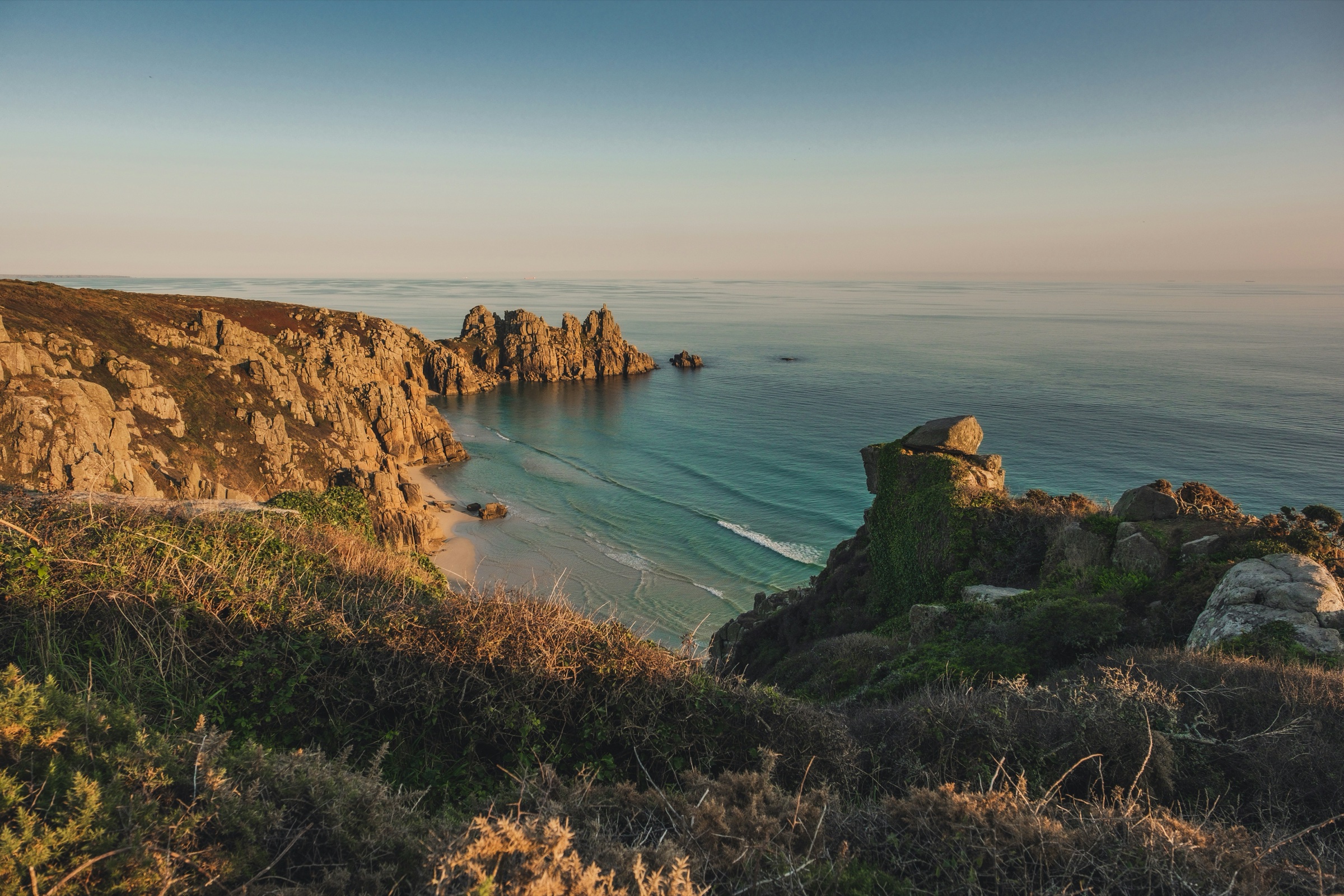
Cornwall’s beaches are the stuff of postcards. Pedn Vounder’s turquoise shallows below Treryn Dinas, the white sand of Porthcurno beneath the Minack, the surf at Sennen Cove and the tidal pool at Porthtowan are among the most beautiful in Britain. Accessible at low tide or high tide, part of the magic is how much each beach changes throughout the day.
Eat a proper Cornish pasty
It would be wrong to leave without one. The genuine article, crimped along the side and filled with beef, potato, swede and onion, is best eaten warm from a village bakery with the sea in front of you. It is as much a part of Cornwall as the coast path itself. Our favourite is McFadden’s Butchers in the Far West.
Spot seals and seabirds
Grey seals haul out on beaches and in coves right around the coast, most reliably at Mutton Cove near Godrevy and from the cliffs of the far west. Bring binoculars, keep your distance, and you will often see them bobbing just offshore.
Planning your visit
Best time to go: late spring and autumn (May, June, September, October) for long light and thinner crowds. See our Cornwall vacation itinerary for how to structure a week.
Where to stay: base yourself across two coasts rather than one. Our guide to where to stay in Cornwall has the best hotels by area.
Getting here: most international guests travel down from London by rail or private transfer. See travelling from London to Cornwall.
See Cornwall with Kernara
The best of these are quiet, hard to find, or better with someone who knows the story behind them. That is what we do. Every Kernara Cornwall tour is a small-group, guide-led journey that strings the finest of them together, with handpicked hotels and nothing to plan. Enquire about a tour to start yours.
Topics